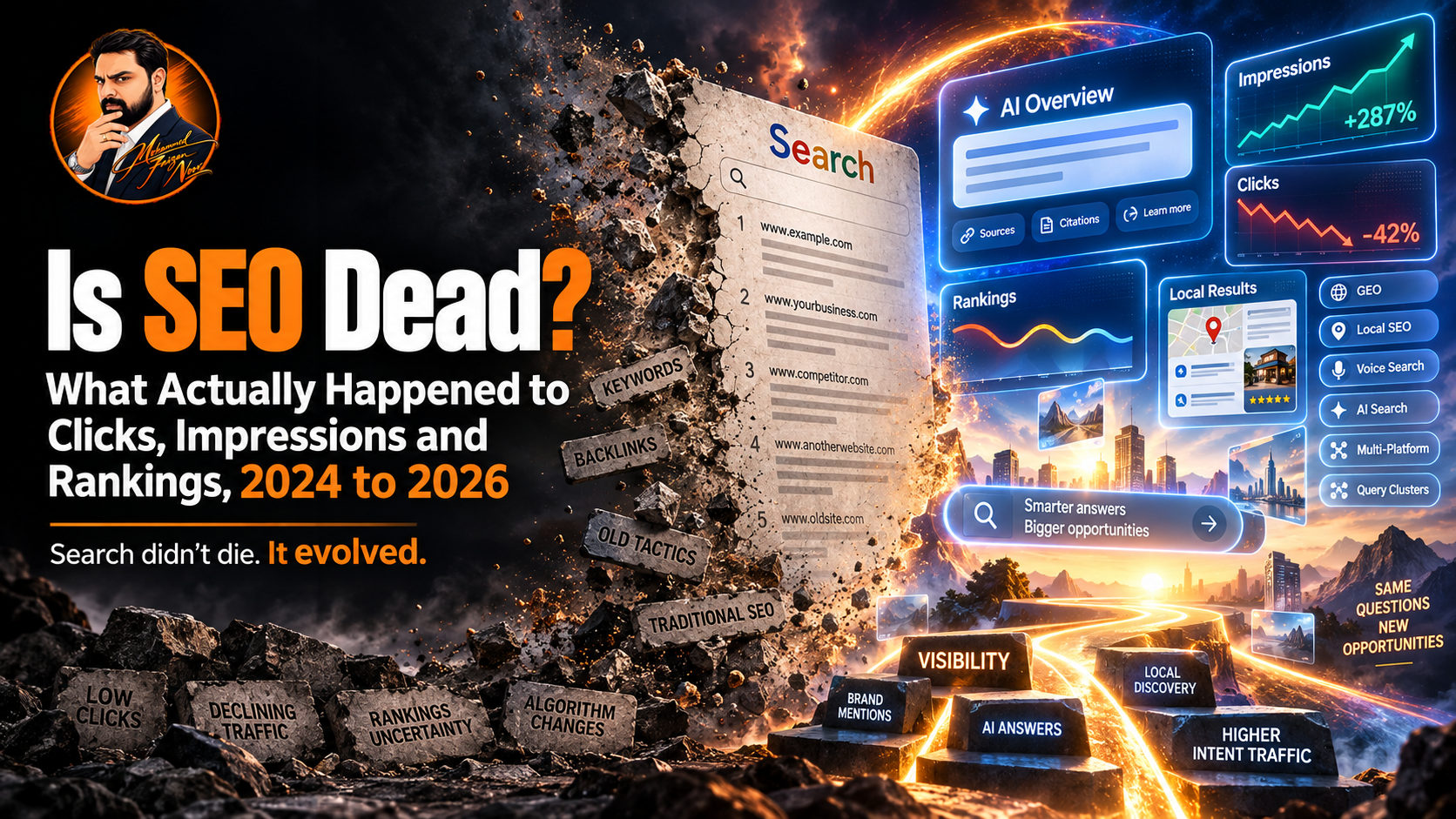

Is SEO dead?
No. Clicks collapsed on one specific class of query, impressions kept growing, and the work changed shape. Anyone answering a flat yes is selling you something new, and anyone answering "it depends" has not looked at their own accounts recently. Here is what the numbers say.
What the data actually shows, twelve months to September 2026
Every article arguing about this is an opinion. Mine would be too, so here are three real accounts instead. All three are anonymised by vertical, all three are Google Search Console, all three cover the same twelve month window to September 2026. Search Console holds sixteen months, which is why this is a twelve month picture and not a 2024 to 2026 one. For the longer arc I use published research, and I have named every source.
Account one: accounting and finance services, UK
This is the clearest version of the pattern. Both lines rise across the year, which is the part people miss when they claim search stopped working, but they rise at completely different rates. By the end of the window, the site is taking roughly twelve thousand impressions on its best days and still counting daily clicks in the low tens. A year of compounding visibility, and the click line barely notices. Enquiries began to grow.
Account two: data and analytics consulting
Visibility climbed from a near standing start last September and held through the middle of 2026 before easing slightly toward the end of the window. Clicks moved with it, loosely, and never proportionally: daily clicks stayed in single figures the whole way while daily impressions ran into the hundreds. Enquiries grew over the same period.
Account three: workflow and operations SaaS
Almost nothing happened until February 2026, and then it started to move, and it was still accelerating when this screenshot was taken. It has the best click through rate of the three and the least to show for it commercially. Enquiries were flat.
Two caveats, before anyone draws the wrong conclusion
Those click through rates look alarming and are mostly explained by something dull. All three accounts sit at average positions between 13 and 21, which puts most of those impressions on page two and beyond. A 0.3 percent click rate at position 19 is not evidence of AI eating the web. It is mostly evidence of position 19. Anyone who shows you a collapsing click through rate and blames AI Overviews without telling you the average position is either being careless or hoping you will not ask.
And these are three accounts I happened to work on, chosen because I can show them, not a random sample of anything. Treat them as a practitioner's read rather than a study.
Impressions grew. Clicks did not keep up.
The clearest pattern across all three is that impressions and clicks came apart. Account B went from a standing start to over a million impressions in a year and took under three thousand clicks for it. Account A did the same thing at a tenth of the scale.
Ten years ago those two lines moved together. You earned visibility, visibility became traffic, traffic became enquiries, and the ratios between them were stable enough to forecast with. That chain has broken in the middle, and it has broken in a way that makes visibility look worthless on a dashboard even when it is doing its job.
The research points the same way at a much larger scale. Rand Fishkin's SparkToro study of Similarweb clickstream data found that 68.01 percent of US Google searches ended without a click in the first four months of 2026, up from 60.45 percent in 2024. Searches producing at least one click of any kind fell 9.51 percentage points over those two years, a 22.9 percent decline. Pew Research Center, watching 68,879 real searches in March 2025 rather than modelling them, found people clicked a normal result 8 percent of the time when an AI Overview was present and 15 percent when it was not. Only 1 percent clicked a link inside the summary.
Which query classes lost, and which never moved?
Averages hide the whole story here, because the loss is not spread evenly. Sorting queries by what the searcher actually wants explains almost all of it. Four classes, in the order they were hit:
- Answered queries. The engine fully substitutes for your page. Definitions, conversions, opening hours, what-is questions, simple how-tos. These are gone, and they are not coming back. If the entire answer fits in a box, the box wins. Pew's data shows the shape of it precisely: 8 percent of one or two word searches produced an AI Overview, against 53 percent of searches of ten words or more, and 60 percent of queries starting with who, what, when or why. The longer and more question-like the query, the more likely something else answers it.
- Considered queries. Comparisons, alternatives, "best X for Y". Impressions rose, clicks thinned, and the click that survives is worth considerably more than it used to be, because the person arriving has already done the shortlisting somewhere else.
- Verified queries. This one is newer and barely gets reported. Someone gets an answer from ChatGPT or an AI Overview, does not fully trust it, and searches to check it against a named source. The click is short, sceptical and high intent. It shows up as brand and long-tail traffic that nobody planned for.
- Transacted queries. Buying intent. Pricing, quotes, near me, book, hire. Largely untouched. The engines have very little incentive to intercept a query that ends in a transaction, and the published data agrees that transactional and navigational searches lost far less than informational ones.
I am calling this a working model, not a measurement. It is how I sort a keyword list before deciding what to write, and it has held up across the accounts above. It is not a finding.
What happened to enquiries, which almost nobody reports?
Two of the three accounts grew enquiries over the same period. One did not.
The two that converted are established businesses with something to sell and a reason for a stranger to trust them. The one that did not is the workflow and operations SaaS, launched recently: it has the best click through rate of the three, at 1.5 percent, and the least business to show for it. That is not a failure of SEO. It is SEO doing exactly what it does, which is take longer than anyone budgets for and produce nothing at all until the offer, the trust signals and the visibility line up together.
Ahrefs reported the same shape from their own funnel: traffic arriving from AI assistants made up about 0.5 percent of their visits and produced 12 percent of signups. Fewer clicks, better clicks. That matches what I see, and it is why a falling traffic line is not automatically a falling business.
This is the number the industry avoids publishing, and it is the only one that decides whether the channel was worth funding. Clicks and enquiries have come apart in the same way impressions and clicks have. If you are still reporting traffic as the outcome, you will reach the wrong verdict about a channel that is quietly working.
Where the death claim comes from?
The death claim rests on four real numbers, and they deserve to be put properly before they are answered. The pessimists are not making this up.
AI Overviews now appear on a large and growing share of queries. BrightEdge put it near 48 percent of tracked queries in February 2026. Ahrefs, updating its own research in the same month, measured a 58 percent fall in click through rate for the top ranking result when an AI Overview is present, up from 34.5 percent in April 2025. Publishers have taken it worst: Similarweb recorded the zero-click rate in news jumping from 56 percent to 69 percent within a year of the US rollout. Gartner forecast in early 2024 that traditional search volume would fall a quarter by 2026, and by direction it was not wrong.
One correction worth making, because the panic usually lands on the wrong feature. If you are blaming AI Mode for this, the timing does not support it: SparkToro found that only 0.34 percent of searches reached AI Mode between January and April 2026. The damage so far is AI Overviews. AI Mode is the thing to watch next, not the thing that already happened.
None of that is spin. If you run a site that exists to answer general questions and monetises the visit, the last two years have been genuinely brutal, and telling those publishers their channel is fine would be insulting.
What actually died?
A real category of SEO work is finished, and pretending otherwise is how agencies lose clients slowly. Named plainly:
- Thin informational content. The 900 word "what is X" post written to catch a definition query. An engine can answer that better than your page, instantly, and it will.
- The volume listicle. Top ten posts assembled from other people's top ten posts. Zero information gain, and the engines now filter for exactly that.
- Ranking as a standalone goal. Position one on a query that produces no clicks and no business is a vanity metric with a report attached. I have watched teams defend rankings while enquiries fell for a year.
- Link building at scale. This is the one I stopped doing myself, and I will come back to it below.
If your SEO invoice is mostly made of those four things, your supplier's version of SEO is dead even if the channel is not.
What did not die?
Five things held up, and the reason each one held matters more than the list itself.
- Commercial and transactional intent. People still search to buy, and the engines still send those clicks. This is where the money in search has quietly concentrated.
- Brand demand. Branded search is the most defensible asset in the channel. AI answers name brands constantly, and a named brand gets searched afterwards.
- Local. Someone standing in a city looking for a service near them still needs a real business with real reviews at a real address. An AI summary cannot fulfil that. The local SEO fundamentals have barely moved in three years, which is unusual and tells you something. Cyrus Shepard's analysis of the sites still winning in Google, cited in the same SparkToro report, lands on the same three survivors: branded search, local, and high intent transactional queries.
- Ecommerce. Product searches still resolve on product pages, because someone has to actually take the payment.
- The technical foundation. Crawlability, rendering, structure and speed decide whether an engine can read you at all. That got more important, not less, because AI retrievers are less forgiving of a page that only appears after JavaScript runs. This is the part of the work that quietly decides whether anything else you do is visible.
What I got wrong
I expected schema and technical work to drive AI citations far more than they actually do.
The logic looked sound: engines need structure, structured data gives them structure, so a well marked up page should get picked. I advised on that basis. In practice, clean schema makes a page eligible and machine readable, and then the engine chooses on something else entirely: whether the page says something the other sources do not, and whether the brand shows up in enough places that the model already trusts it. I have seen immaculately marked up pages ignored while a messy forum thread earned the citation.
Schema still earns its place. It is cheap, it helps eligibility, and skipping it is silly. But I was selling it as a lever when it is closer to a prerequisite, and I have stopped presenting it as the answer to an AI visibility problem.
Will AI replace SEO?
No. AI changed the surface, not the underlying job.
The job has always been to make a business the thing that gets recommended when somebody is looking. The surface used to be ten blue links. Now it is a summary, a chat answer and a set of citations. But an engine that generates answers still has to get those answers from somewhere, and everything in the sourcing chain (being crawlable, being clear, being credible, being mentioned in the places the engine reads) is the work SEOs have always done.
What AI genuinely replaced is the repetitive middle of the job. Keyword clustering, first drafts, bulk reporting, basic technical checks. That is real, and if that was your entire role, it is worth learning the rest quickly.
Is SEO worth it in 2026?
It depends on one thing, and it is not your industry.
It is worth it if you are prepared to spend beyond on-page and technical work. Search in 2026 rewards reputation, credibility and genuineness, and those are not on-page tasks. They are built through evidence, real expertise, being cited elsewhere, and being a business people vouch for. When somebody asks me to do the on-page and technical work alone and nothing else, I tell them honestly that the money will not come back.
It is also not worth it without patience. Nine to twelve months is the realistic window before search does anything for a new site, and account C above is the proof. Good click through rate, zero business, twelve months in. If you need pipeline this quarter, buy ads and come back to search when you can afford to wait.
The future of SEO
Three things I expect to be true by 2028, written so I can be shown to be wrong.
- Impressions become the leading indicator and clicks become a lagging one. Teams that forecast from clicks will keep mispricing the channel. The useful question is how often you appeared, in front of whom, and what they did next.
- Bing gets a second life through Copilot. Copilot is grounded in Bing, and almost nobody optimises for Bing properly. That chain from Bing index status to Copilot citation is the least contested route into an AI surface right now, and it will not stay uncontested.
- Measurement fragments before it consolidates. Citation tracking vendors currently disagree with each other because they measure different denominators. Expect two more years of incompatible numbers before anything standard arrives. Do not build your reporting on one vendor's definition.
Is blogging dead? Is content marketing dead? Is link building dead?
- Is blogging dead? No, but publishing to hit a monthly quota is. A blog post now has to carry something the engines cannot assemble from ten other pages: your data, your testing, your client work, your position. One post a month with original evidence beats eight without. If you cannot say what a post knows that nothing else does, do not publish it.
- Is content marketing dead? No. The content that exists to capture search volume is dying, and the content that exists to demonstrate expertise is more valuable than it has been in a decade, because it is the raw material AI engines quote when somebody asks for a recommendation.
- Is link building dead? The version I used to do is. I stopped buying guest posts and running link campaigns at scale in 2024, and I replaced it with four cheaper things at once: placements on the listicles and directories the AI engines actually cite, digital PR and unlinked brand mentions on authoritative sources, original data that earns links without anyone asking, and turning up in the communities where buyers already ask the question. Links still matter. Buying them stopped being the efficient way to get them.
How to check whether SEO is dead for you specifically
Open Search Console, set the range to the last sixteen months, and compare impressions against clicks. If impressions are flat or falling, this is a visibility problem and AI is not your issue. If impressions are climbing while clicks are not, you are in the situation described above and the fix is to change what you publish, not how much.
Then sort your queries into the four classes. If most of your traffic came from answered queries, a real part of your traffic is gone for good. If it came from transacted queries and it is falling, something else broke. If you want a second pair of eyes on what the numbers are saying, that is the kind of work I take on.
What I would do if I were starting today
In this order, and I would not skip ahead.
- Make the site readable by machines before anything else. Server rendered HTML, clean crawl access for the retrieval bots including Bingbot, fast pages. If an engine cannot fetch you, nothing below matters.
- Build the pages that answer transacted and considered queries. Services, pricing, comparisons, locations. These still convert and still get clicked.
- Publish one thing a month that nobody else can. Your numbers, your test, your client results. One original piece is worth ten summaries of other people's work.
- Get named in the places engines read. Directories, listicles, credible third party coverage, and the communities where your buyers ask questions. Brand mentions do more for AI visibility than another hundred pages.
- Report enquiries, not traffic. From day one. If you report clicks, you will kill the channel in month eight, right before it starts working.
- Then, and only then, worry about schema. It helps. It is not the lever I once thought it was.
Frequently asked questions
Is SEO dead in 2026?
No. Clicks fell sharply on informational queries that AI can answer directly, while commercial, transactional, local and branded searches held up. The channel changed shape rather than ending.
Will AI replace SEO?
No. AI automated the repetitive parts, keyword clustering, first drafts and reporting. The core job, making a business the thing that gets recommended, still has to be done by someone, and AI engines still need sources to build answers from.
Is SEO still worth it for a small business?
Yes, if you can wait nine to twelve months and are willing to invest beyond on-page and technical work in credibility and reputation. No, if you need pipeline this quarter or only want the technical checklist done.
Is blogging dead?
No. Publishing for volume is dead. A post carrying original data, first-hand testing or genuine expertise is now worth more than it was, because it is what AI engines quote.
Has AI killed organic traffic?
It has cut it significantly on informational queries. SparkToro found fewer than a third of Google searches now send a click, and Pew measured click rates roughly halving when an AI Overview is present. Transactional and branded traffic has been far less affected.
What is replacing SEO?
Nothing is replacing it. Generative engine optimisation is being added to it: the same discipline extended to surfaces like ChatGPT, Perplexity, Copilot and AI Overviews, where the goal is being cited rather than being clicked.
Is SEO still a good career in 2026?
Yes, if you move up the stack. Demand shifted toward strategy, technical work, measurement and AI visibility, and away from execution tasks that tools now handle. The people at risk are the ones doing only what a tool can do.
Is SEO dead or just changing?
Changing, and the change is specific rather than vague. Queries an engine can answer completely are gone. Queries that end in a decision or a purchase are intact. The work moved from earning clicks to being the source an answer is built from.
Is organic SEO dead?
No. Organic clicks fell on informational queries and held on commercial ones. What died is the assumption that an organic ranking automatically produces a visit, which was always the shakier half of the deal.
Is SEO dead after AI Mode in Google?
Not yet, and the timing is clear about why. SparkToro found that only 0.34 percent of searches reached AI Mode between January and April 2026, so the damage so far belongs to AI Overviews. AI Mode is the thing to watch next, not the thing that already happened.
Is SEO actually dead, or are people just bad at it?
Both things are true at once, which is why the argument never resolves. A real category of work stopped producing results, and a lot of people kept selling that category anyway. If your SEO stopped working in 2024 and nothing about your approach changed since, the second explanation is more likely than the first.