
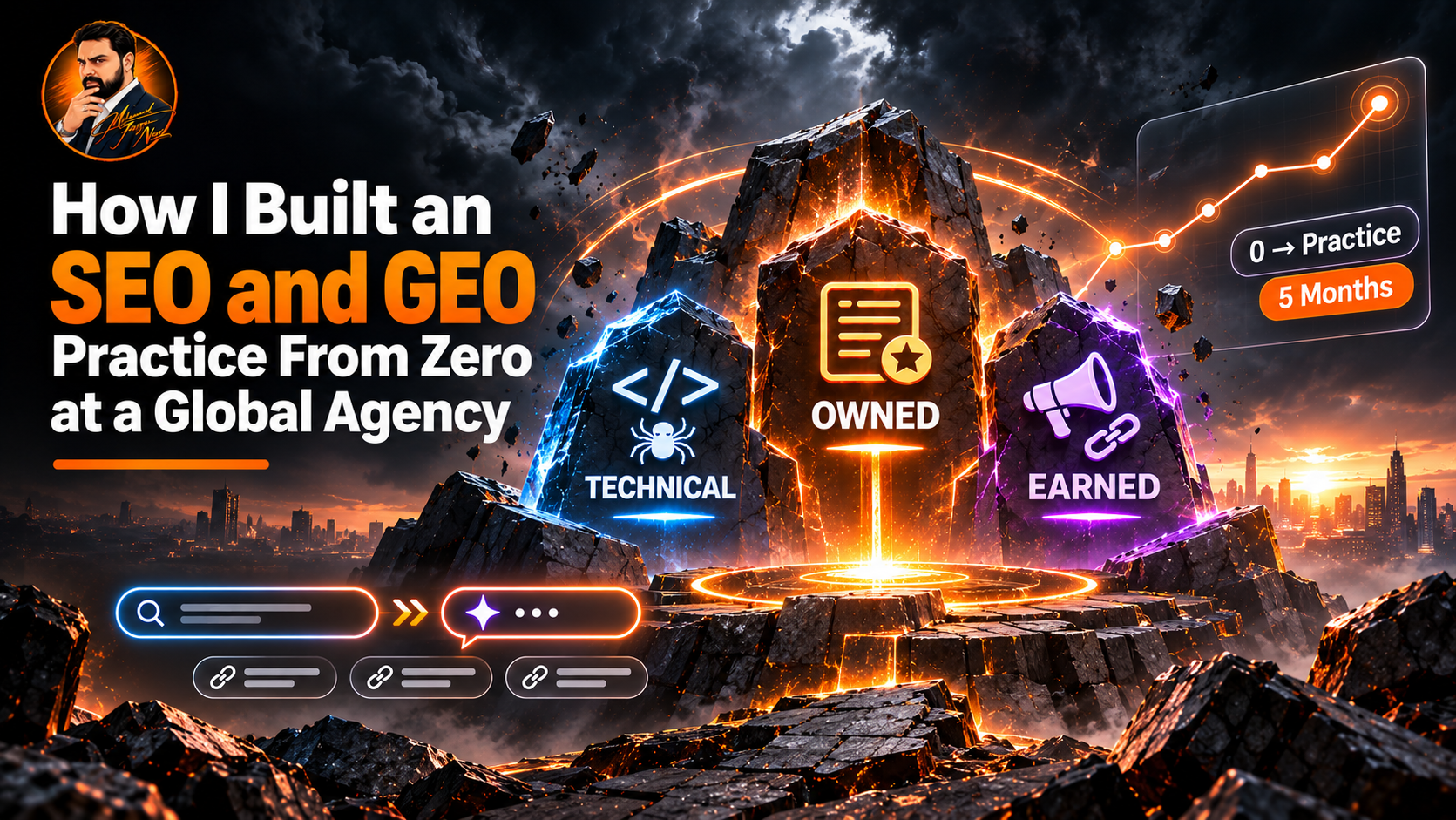

What does it take to build a GEO practice inside an agency?
A GEO practice is an agency service line that gets clients named and cited inside AI answers, built on SEO foundations and run with its own method, measurement and earned media work. It takes a method before it takes a tool. An agency can buy every AI visibility tracker on the market and still have nothing to sell, because the trackers report where a brand appears and stop there. What a client pays for is the order of work: what to fix first, what to publish, and whose coverage to earn.
I learnt that the slow way. This is the story of how one contract role became a global SEO and GEO practice in five months: the first month with no stack, the tools I tested and dropped, the approach I ended up with, the pitches where PR budget was the real opportunity, and what we proved on our own domain before we asked a client to trust any of it. No client names and no client numbers. The lessons travel without them, and they build on the earlier field notes on this blog.
What did day one of building a GEO practice look like?
I started with a laptop, a login and a deadline. SEO and GEO were new service lines for the agency, and the brief was simple to say and hard to do: build them into something clients would pay for.
In the first month I had four audits due, in four very different industries. I set up my tools in the first week, wrote the audit template while I was using it, and delivered all four.
That month taught me the first rule of building a practice: the template you write under pressure becomes the product. Every shortcut I took in month one, I either fixed or sold for the next year. So I started writing everything down the second time I did it.
How did a commerce graduate end up building a GEO practice?
I did not study marketing technology. I studied commerce, then business administration, and started in 2017 running programmatic ad operations. SEO came later and almost by accident, a story I tell in full in how I started in SEO and moved to GEO.
| Years | Role | What it taught me |
|---|---|---|
| 2017 to 2019 | Ad ops, then digital marketing at an edtech portal and a robotics ecommerce store | Ranked the store #1 on Google for "Raspberry Pi". Search is a sales channel, not a report. |
| 2020 to 2024 | Solo SEO for an HR software company, carried through its acquisition by a fintech | When you are the only SEO, you do the technical, the content and the reporting. Nobody hands you a process. |
| 2024 to 2025 | Assistant manager, then SEO team lead at a mid-size Indian performance agency | Leading four specialists and two writers across 20+ enterprise accounts. Where I introduced AEO and GEO as services in 2025. |
| Oct 2025 onwards | Contract consultant, then global SEO and GEO lead at a global agency | Building a practice, not running one. |
Each step mattered for the last one. The solo years made me fast at audits. The team lead year taught me that a method in my head is useless to six people. And introducing GEO at the mid-size agency, before most clients were asking for it, taught me the hardest lesson early: a client will not buy a channel they cannot see in their own analytics. I wrote about that measurement gap in what actually happened to clicks between 2024 and 2026.
Is GEO just SEO with a new name?
Mostly yes, and that is the point. GEO is SEO evolved for a search layer that answers instead of listing. The foundations did not change: crawlable pages, clear entities, real expertise, and a reputation on other people's websites. What changed is the finish line. You used to win a position. Now you win a sentence inside someone else's answer.
I think of large language models as an advanced search engine sitting on top of everything SEO and reputable publishers already put on the web. When someone asks ChatGPT or an AI Overview a question, the engine retrieves sources, weighs them, and summarises. If your page was never findable, clear or trusted, there is nothing for it to summarise.
Google says the same thing in plainer words. Its own guide to optimising for generative AI features states that "the best practices for SEO continue to be relevant", and tells site owners they do not need special AI-only tactics for Google Search.
But it is not identical, and pretending it is would be lazy. Ahrefs looked at roughly 4 million AI Overview URLs across 863,000 keyword SERPs and found only 37.9 percent also appeared in the top 10 for the same query. So ranking helps, and it is not the whole game. The engine reads widely and picks what adds something. It is also why visibility and clicks have come apart, which I unpacked in how to tell an AI traffic loss from a core update.
| SEO | GEO | |
|---|---|---|
| Unit of search | A keyword | A prompt, often a full question |
| What you win | A position on a results page | A mention or a citation inside an answer |
| Scorecard | Rank, clicks, CTR | Share of voice, mention rate, citation rate |
| What decides it | Relevance, authority, technical health | The same, plus whether third parties repeat your story |
| Stability | Rankings move weekly | Answers change run to run |
That last row matters more than people admit. SparkToro and Gumshoe ran 12 prompts 2,961 times across ChatGPT, Claude and Google's AI and found less than a 1 in 100 chance of getting the same brand list twice. One screenshot of one answer proves nothing. Rand Fishkin put it more bluntly: "any tool that gives a 'ranking position in AI' is full of baloney." A fixed prompt set, run repeatedly, proves a trend.
The original research that named the field, the Princeton and Georgia Tech GEO paper, found that adding citations, quotations and statistics lifted visibility in generative answers by up to 40 percent in their tests. Credibility work, in other words. The same work good SEO always was.
How has search behaviour changed, and why does it matter to agencies?
Buyers now ask full questions, read one synthesised answer and click far less. SparkToro's clickstream study found 68 percent of US Google searches ended without a click in the first four months of 2026, and Pew Research found people clicked a normal result 8 percent of the time when an AI Overview appeared, against 15 percent when it did not. I unpacked what that did to real accounts in my analysis of clicks between 2024 and 2026.
What I see in client work is a three-step journey: ask an AI engine, shortlist from its answer, then search the brand to check it. The first step leaves no session in analytics, which is why AI influence shows up later as direct and branded traffic. For an agency, that changes the product. You are no longer selling a position on page one. You are selling presence in the answer, and proof that the brand holds up when the buyer checks.
Which GEO tools did I test, and what did none of them do?
Before I built a method, I tried to buy one. Over the first few months I ran trials and paid seats across the AI visibility trackers and the classic SEO suites: Ahrefs with Brand Radar, Semrush's AI toolkit, Profound, Peec AI and Frase, plus Screaming Frog and the usual validators for the technical side.
The honest verdict: every one of them is good at telling you where you stand. Several will even hand you a list of fixes. Not one of them told me which fix comes first, or sorted the work into the part of the business that owns it. A missing schema block, a blocked crawler and an absent review-site listing all arrive in the same list, with the same urgency, and they belong to three different teams.
The trackers also disagree with each other, because they measure different denominators. One counts share of all citations, another counts share of answers that mention you at all. Neither is wrong. Put them side by side in a client report and you will spend the meeting explaining the gap instead of the plan. Mentions and citations are not even the same event: a Semrush study run with Kevin Indig found 61.7 percent of AI citations linked a brand's page without naming the brand in the answer. So I report the two separately, always.
| What the tools did well | What they left to me |
|---|---|
| Baseline visibility across ChatGPT, Gemini, Perplexity, Copilot and AI Overviews | Deciding which prompts are worth winning at all |
| Listing cited domains and competitor mentions | Separating sources you can out-write from sources you can only pitch |
| Flagging technical and on-page issues | Ordering fixes by business impact, not tool severity |
| Sentiment on brand mentions | Turning negative or missing coverage into a PR brief |
So the stack stayed small. Ahrefs and Brand Radar for search and AI tracking, Screaming Frog for crawling, one multi-market tracker for audits across languages, and Claude and Copilot automation to take the grind out of research and drafting. Everything else on the list above became a reference, not a dependency. The method had to live with us, not inside a vendor.
What GEO framework do I use? Three questions, three pillars
The approach I ended up with is three questions a client can answer without knowing any jargon. Each question is a pillar, each pillar has an owner, and each has a weight that tells the client where the budget should go.
| Pillar | The question | Who owns it | What we fix | Weight |
|---|---|---|---|---|
| Technical | Can AI read your site? | Web and dev team | Crawler access for AI agents, rendering of JavaScript-heavy pages, organisation and person schema, titles, headings, internal links | 25% |
| Owned | Are you the source of the answer? | Content and SEO team | Prompt and topic mapping, answer-first pages, FAQ coverage, author bylines, local and sector pages | 35% |
| Earned | Who speaks your story when you are mentioned but not cited? | PR, comms and partnerships | Press placements, directories and review platforms, Wikipedia, Reddit and community surfaces, the publishers AI already cites | 40% |
The pillars run at the same time, not in sequence. But the order of fixes inside them matters, and access always comes first. No amount of content or PR compensates for a site an AI agent cannot read. On one audit, a handful of important navigation pages had quietly been hidden from search. That single finding outranked everything else in the deck, and it took an afternoon to fix.
Every audit we deliver now sorts findings into P1, P2 and P3 by impact on visitors and search, and by how important the affected pages are. Not by the severity a tool assigns. A tool says thousands of pages have no meta description and calls it critical. A strategist asks which twenty of those pages carry the brand.
What happens when AI mentions you but cites someone else?
The most valuable finding in GEO is rarely "you are invisible". It is "AI already names you, and then quotes somebody else". When that happens, the brand is in the answer but a third party is telling the story. That is a reputation problem dressed up as a search problem, and it is where GEO and online reputation management overlap.
I saw the same pattern again and again, across non-profit, public sector and destination brands: strong recognition, real authority, and yet the citations went to encyclopaedias, news coverage and explainers written by other people.
In each case, the budget conversation changed the moment we showed it. The client already had communications and PR spend, usually measured on coverage volume. Nobody was asking whether that coverage landed on the publishers the AI engines actually read. Reframing existing PR budget as a GEO lever, with a target list built from the domains AI cites for the prompts that matter, was a bigger opportunity than any new page we could write. That is the pitch angle I now look for first: not new money, but money already spent in the wrong place.
The performance version of the same idea came from a consumer app audited across several markets, in English and in local languages. Two patterns carried the room:
- The brand's share of AI answers fell from 30 percent in English to 22 percent in the local language, and the share of prompts that never named it rose from 47 to 60 percent. Same product, same market.
- Sentiment can tell a different story from share of voice. A brand can be named in most answers and still be described negatively in a meaningful share of them. Visibility you cannot control is not always good news.
That is why I treat AI as a reputation channel, not only a traffic channel. Ahrefs' study of brand mentions across 260 million prompts and 10,000 brands found every mention type correlated with AI visibility. Reddit threads correlated most strongly (0.75), and news articles (0.67) carried no extra weight over ordinary web pages (0.70). The authors are careful to call it correlation, not cause. That last detail changed how I write PR briefs: a press hit is one mention among many, not a golden ticket. On cause, I hold the same line. What I can say from the work is simpler: the brands AI trusts are the brands other trusted sources keep talking about. Becoming the source AI trusts is mostly earned, not written.
How did we prove GEO worked before selling it?
We ran the method on the agency's own website first, because nothing about that needed client permission and everything about it would be questioned in a pitch. Organic search was softening, AI Overviews were appearing above the results in our category, and buyers were researching in ChatGPT and arriving as Direct, or not arriving at all.
From October I ran the programme across all three pillars: organisation and person schema, AI crawler access opened, location and service pages rebuilt on an SEO and GEO template, the blog rebuilt for readability and retrieval, author pages, directory and review profiles updated, and press placements aimed at the publishers AI cites in our category.
It worked, in the way this channel works. Over twelve months, LLM referral traffic to the site grew steadily, the visitors it sent converted better than the average visitor, and a growing share came from engines other than ChatGPT. I am keeping the numbers private because they belong to the agency. The direction matches the wider market: Limy, citing Similarweb data, reports that AI platforms sent more than 1.13 billion referral visits to the world's top 1,000 websites between June 2024 and June 2025, up 357 percent year on year.
What we are working on now is the earned pillar, because that is where the answers come from. Profound's analysis of 680 million citations found that Wikipedia made up 47.9 percent of ChatGPT's ten most-cited sources, while Reddit made up 46.7 percent of Perplexity's and 21 percent of Google AI Overviews'. So the next phase is less about our own pages and more about the places engines already trust: encyclopaedic entries, community answers, video and the publishers that keep appearing in our category.
How do you turn one person into a GEO practice?
A practice is what keeps working when you are on leave. Getting there took five things, roughly in this order.
- A first paid engagement. It came within the first few months, and that one deal did more for internal belief than any deck.
- A paid GEO audit. The first engagement sold as GEO, not SEO with an AI slide at the end.
- A repeatable delivery system. The approach, a standard prompt set per category, AI visibility tracking, and Claude and Copilot automation for research and drafting. Monthly output roughly doubled without the quality dropping.
- People. I hired and coached the first specialist on the team and grew it from there.
- An agency that could sell it. I trained business development and account teams across the US, UK, EMEA and APAC, so GEO came up in conversations I was not in. We also ran an external GEO webinar that drew over 100 registrations.
In March 2026, five months in, the contract became the global lead role. The title mattered less than what it signalled: the agency was treating SEO and GEO as a service line, not an experiment.
What did building my own site with ChatGPT teach me?
The site you are reading is my lab. I designed and built itsfaizan.com and its CMS myself, with ChatGPT as the build partner, so I could test SEO and GEO ideas on a domain where nobody needs to sign off.
The pace surprised me. On 11 September 2026 I asked for a protected CMS, an editable homepage and a blog without touching the existing design. By the next day the owner-only admin and the blog were live, and the first article was published that same week. Refinement has not stopped since: over 70 recorded versions so far.
What went into the templates, because each one is a GEO decision:
| Feature | Why it is there |
|---|---|
| TL;DR block above every article | The first 100 words are what retrieval systems read most |
| Summarise with ChatGPT, Perplexity, Gemini and Claude buttons | Put the article into the engines readers already use |
| Person, WebSite, Article, FAQ and Breadcrumb schema | Make the author and the page an unambiguous entity |
| Byline, author bio and profile links on every post | Experience and authorship, visible to readers and machines |
| Permissive robots.txt, dynamic sitemap, RSS and llms.txt | Nothing between a crawler and the content |
| Markdown versions of pages and articles | Clean text for extraction, without the layout |
| Table of contents with jump links | Every section is addressable on its own |
It was not a flawless AI build, and that is the useful part. The CMS got stuck in a reload loop. Blog routes clashed until I moved them and added redirects. The revision table bloated until I capped history at three versions. Mobile performance sat at 61 on PageSpeed until the logo went from 432 KB to 48 KB and blocking fonts were removed; it now sits in the low to mid 70s. One font experiment made things worse and was rolled back.
Two lessons came out of it. AI as a tool is a very fast junior partner: it builds in a day what used to take weeks, and it still needs someone who knows what good looks like to test, question and roll back. AI as a search engine is a different animal: a perfectly structured site is eligible to be cited, not entitled to it. Building this site is exactly how I found out that structure was the price of entry, not the lever.
How should an agency leader build a GEO practice today?
If I were starting the practice again tomorrow, I would do it in this order and not skip ahead.
- Write the method before you buy the tools. Decide your pillars, your priority rules and your report shape. Then pick tools that feed it. The reverse gives you five dashboards and no plan.
- Run it on your own domain first. Your own site is the only case study nobody can refuse to let you publish, and the first question in every pitch is "does this work for you?"
- Fix access before anything else. Check robots rules for the AI search crawlers, CDN bot settings and JavaScript rendering. Know which bot does what: OpenAI separates OAI-SearchBot, which surfaces sites in ChatGPT search, from GPTBot, which collects training data, and blocking one does not block the other. It is the cheapest finding and the one most often missed.
- Split every prompt into two routes. If competitors' own pages hold the answer, out-write them. If third-party sources hold it, no page you publish will win it. Pitch those sources instead.
- Look for PR budget, not new budget. Most large clients already pay for communications. Point it at the publishers AI cites.
- Measure with a fixed prompt set, run repeatedly. Report trends and rates, never a single screenshot. Report enquiries and conversions next to visibility, or the channel gets cut in month eight. I made the same argument about clicks in the zero click piece.
- Train the people who sell. A GEO practice that only its lead can explain is a consultant, not a service line.
What did I get wrong?
I sold structure as a lever for too long. Schema, FAQ blocks and clean headings make a page eligible, and then the engine chooses on something else: whether the page says something new, and whether the brand is talked about elsewhere. I now present technical work as the price of entry, not the win. I wrote more about that shift in Is SEO dead?.
I also under-priced the earned pillar early on. It is slow, it needs people outside the search team, and it does not fit a neat monthly deliverable. It is also the pillar that moves a brand past mid-pack. If I had weighted it at 40 percent from the first pitch rather than arriving there, the first few programmes would have moved faster.
Frequently asked questions
What is a GEO framework?
A GEO framework is a method for deciding what to change so a brand gets named and cited in AI answers. The one I use asks three questions: can AI read your site (Technical), are you the source of the answer (Owned), and who speaks your story when you are mentioned but not cited (Earned).
What is the difference between GEO and SEO?
SEO wins a position on a results page; GEO wins a mention or citation inside an AI answer. They share the same foundations, and Google says SEO best practice still applies to its AI features. GEO adds prompt tracking, citation analysis and third-party reputation work.
How long does it take to build a GEO practice in an agency?
In my case, five months from a solo contract to a global lead role with paying clients, a team and a repeatable delivery system. The first paid engagement came before the method was finished.
What tools do you need to start a GEO service?
Fewer than vendors suggest: an SEO suite with AI tracking, a crawler, and a fixed prompt set you run repeatedly. Every tracker diagnoses well. None will prioritise the work for you.
Is GEO part of online reputation management?
Partly. When AI names your brand but cites someone else, a third party is telling your story. Fixing that is earned media and reputation work, which is why PR budgets are often the biggest untapped GEO lever.
Can you guarantee a brand will be cited by ChatGPT?
No, and anyone who does is overselling. AI answers vary run to run. What you can promise is measurable movement in mention and citation rates across a fixed prompt set, tied to enquiries.
Should an agency build a separate GEO team or extend its SEO team?
Extend SEO first, then add what it lacks. The technical and owned pillars sit naturally with SEO and content; the earned pillar needs PR and comms at the table. I started with one person and a method, not a new department.
How do you measure GEO for a client?
Run a fixed set of prompts across the engines that matter, repeatedly, and report mention rate, citation rate and share of voice as trends. Put AI referral sessions and conversions from analytics next to them, so visibility is always read against business outcomes.
Sources
- Google Search Central, Guide to optimising for generative AI features, updated 10 July 2026
- SparkToro, Rand Fishkin, In 2026, less than one third of Google searches still send a click, June 2026
- Pew Research Center, Google users are less likely to click on links when an AI summary appears, July 2025
- Ahrefs, Linehan and Guan, AI Overview citations and the top 10, 2 March 2026
- Ahrefs, Linehan and Guan, Mention types and AI visibility, 3 November 2026
- SparkToro, Fishkin with Gumshoe, AIs are highly inconsistent when recommending brands, 27 January 2026
- Semrush with Kevin Indig, The ghost citations study, 9 June 2026
- Profound, Nick Lafferty, AI platform citation patterns, 680 million citations, August 2024 to June 2025
- Limy, This is where visibility becomes revenue, citing Similarweb, December 2025
- OpenAI, Overview of OpenAI crawlers
- Aggarwal et al., GEO: Generative Engine Optimization, Princeton and Georgia Tech