
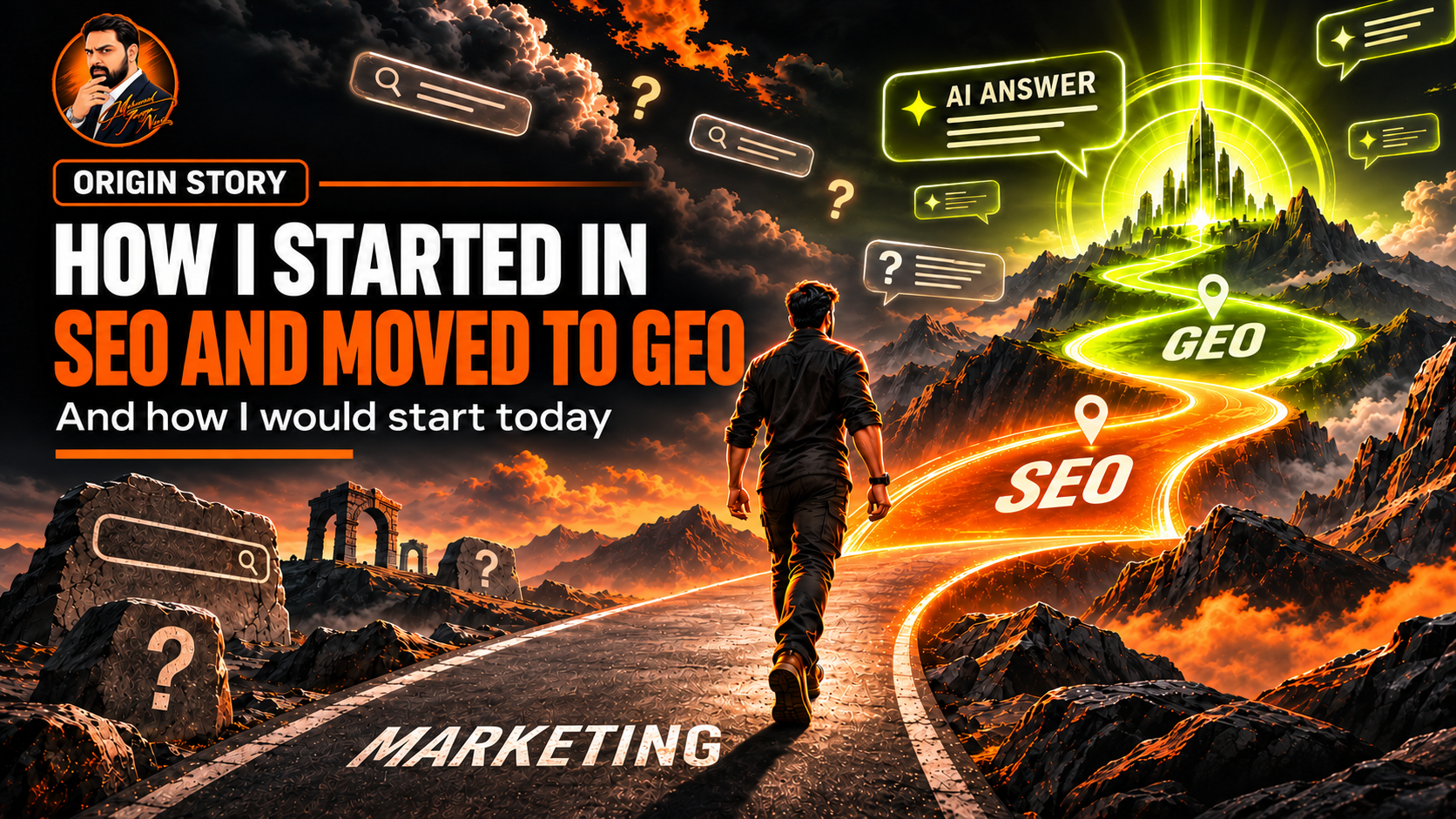

How do you start a career in SEO and GEO in 2026 and 2027?
Start with SEO fundamentals, then add GEO within months, not years. You do not need a marketing degree or expensive software. You need a website on your own domain, an understanding of how search engines find content, and practice measuring what works.
- Build a website on your own domain.
- Learn crawling, indexing, search intent and Google Search Console.
- Publish, improve and measure real pages.
- Learn how AI engines mention and cite you, and document every experiment.
The detailed version is in my 90-day plan to start SEO and GEO below.
That is how I would approach it today. Here is how I got there the slow way, long before I built the SEO and GEO practice at a global agency that I wrote about last time.
How did a BBA graduate with no plan end up in SEO?
By reading blogs, taking one course and then drifting towards whatever I enjoyed most. I finished a BBA with no career plan at all. What I did have was a habit of reading digital marketing blogs late at night, Neil Patel's above all. His posts made marketing feel like something you could test and measure, not just pitch.
So I signed up for a digital marketing course at a well-known professional training institute. My family was weirdly against it. In their heads, digital marketing meant becoming a salesman, and that was not the plan anyone had for me. I went anyway. My trainer taught our batch Google Ads properly, and I came out certified.
The certificate got me my first job: ad operations at a media ad-tech firm. I delivered campaigns other people had planned, and my click-through rates came in about 20% above benchmark. I was good at it. I was also not happy. Delivering someone else's plan is not the same as building your own.
The phone cases that settled the salesman argument
The irony is that the salesman bit turned out to be true, and it happened during that ad ops job. I started making custom phone cases for my mum. Then her friends wanted one. Then family friends. Before long I was selling them on eBay, and the side project made ₹20,000. That paid for flights to Goa and adventure activities for my brother and me when we went for a family wedding.
I come from a Memon family, part of a Gujarati trading community, and I joke that selling is in the blood. Whatever the reason, those phone cases taught me things a course never did: write a listing that answers the buyer's question before they ask it, price against what is already on the page, and earn trust with reviews. Years later I realised that is most of SEO, and now most of GEO too.
Lesson: a certificate gets you an interview. A small thing you built and sold, with your own numbers, gets you taken seriously.
What did the detours teach me?
Every detour taught me one part of SEO without calling it SEO. After ad ops I edited videos for a crypto learning start-up. I learnt how people explain hard topics simply, and I learnt my only real regret from that job: not buying Ethereum when it was still affordable.
Then I ran email marketing for an education portal. Open rates sat around 25% and click-through around 8%, which kept everyone happy. Meanwhile I was secretly reading about SEO every evening, because organic search was where students actually found us.
The robotics store was where it clicked. I was hired for 360 digital marketing, which meant sales, social, partnerships and SEO all at once. Small on-page fixes compounded, with organic growth of around 20% in some months, and the store reached number one on Google for "Raspberry Pi". I also found out I was good at B2B sales, which made sense after the phone cases.
I started on WordPress. Those early sites are where I first learnt how titles, permalinks, plugins and sitemaps actually change what Google shows, by breaking them and fixing them again. It is still the platform I would point most beginners to first.
| Role | What I actually did | What it taught me for SEO and GEO |
|---|---|---|
| Ad operations | Delivered paid campaigns | Intent: people click what matches their question |
| Side hustle | Sold custom phone cases on eBay | Listings, pricing against the page, reviews as trust |
| Video for a crypto start-up | Edited explainer videos | Explaining hard topics simply, which AI engines reward |
| Email for an education portal | Ran newsletters and lead nurture | Subject lines are titles, and titles earn the click |
| Robotics store | 360 marketing, sales and SEO | Product pages, category pages and compounding fixes |
None of these looked like an SEO career on paper. Together they were a better education than any single course.
When did SEO stop being a side interest?
At a VR start-up, when Google would not show the company for its own name. Type the brand and you got everything except the brand. That is an embarrassing problem for a tech company, and it landed on my desk.
Fixing it meant understanding how Google decides what a brand is: consistent naming across the site and the web, clean structured data, profiles that point back to one source of truth, and pages that say plainly who you are and what you do. I rebuilt the site around SEO, the brand started showing up, and conversions rose by about 20%.
I did not know it then, but that was my first GEO problem. Today the question is not only "does Google show my brand" but "does ChatGPT know who we are, and does it describe us correctly". The fix is the same family of work: be clear about your entity, be consistent everywhere, and give machines something trustworthy to quote. I wrote about why that makes SEO more relevant, not less, in Is SEO dead?
From then on, SEO was not a side interest. It was the job I wanted.
How did COVID turn me into an accidental SEO?
It took away every other option. When the lockdowns hit, a former intern of mine had just founded a media start-up with four friends, and they asked me to consult. Businesses everywhere needed to get online fast, and I helped more than 100 small businesses do it. Websites, listings, search basics. I had become an SEO consultant without ever applying for an SEO job.
Then came my first proper SEO role, as the only SEO person at an HR software company serving more than 10,000 businesses. There was no budget for a paid SEO tool. So I ran experiments that would make a tool vendor wince: Search Console exports in spreadsheets, free crawlers, manual SERP checks, and a homemade toolkit I built to fill the gaps.
It worked. Organic traffic grew around 20% year on year, qualified leads from organic rose about 40%, and the programme survived the company being acquired by a fintech. On the side, I consulted brands for a family-run creative agency, which kept me honest about small budgets and real deadlines.
Not having a paid tool is no excuse. Google Search Console, Bing Webmaster Tools and a spreadsheet will teach you more about SEO than a dashboard you do not understand. Tools speed up good thinking. They do not replace it.
How did I move from SEO to GEO?
By noticing that clients were being answered without being clicked, and learning fast enough to do something about it. In 2024, I joined a mid-size agency as SEO team lead, with four specialists and two writers across more than 20 accounts. AI Overviews were rolling out, ChatGPT was becoming a search habit, and our reports could not explain what was happening. So I upskilled into GEO and introduced it to our clients.
Generative Engine Optimisation (GEO) is the practice of making a brand visible, accurately described and cited inside AI-generated answers from engines like ChatGPT, Perplexity, Gemini, Copilot and Google AI Overviews. The term comes from a 2023 Princeton-led research paper, which found that adding sources, statistics and quotations could lift a page's visibility in AI answers by up to 40%.
What is the difference between SEO, GEO and AEO?
SEO earns rankings and clicks, AEO earns the direct answer, and GEO earns a mention or citation inside an AI-generated answer. In practice they share one foundation and differ in what counts as a win.
| SEO | AEO | GEO | |
|---|---|---|---|
| Full name | Search Engine Optimisation | Answer Engine Optimisation | Generative Engine Optimisation |
| Goal | Rank and earn the click | Be the direct answer | Be named and cited in an AI answer |
| Where | Google and Bing results | Featured snippets, voice, AI Overviews | ChatGPT, Perplexity, Gemini, Copilot, AI Mode |
| Unit of success | A page's position | A short, extractable answer | A passage, a mention or a citation |
| Main signals | Relevance, links, technical health | Clear question-and-answer structure | Clarity, evidence, consensus across the web |
| How you measure | Search Console, rank tracking | Snippet and AI Overview presence | Prompt tracking, mentions, AI referrals |
How does generative engine optimisation work?
AI search engines often break a question into several searches, retrieve pages, and quote the passages that answer most clearly and credibly. GEO is the work of making your pages easy to retrieve and worth quoting (answer-first writing, sources, statistics, consistent facts about your brand), and of getting other trusted sites to say the same things about you.
So is GEO a separate career? Not yet, but it is heading that way. SEO is the strongest foundation for GEO, but GEO adds skills SEO alone does not cover, such as digital PR, reputation work and measuring answers that change every time you ask. Google says the same SEO best practices apply to its AI features in Search, and in my audits the brands cited most are almost always the ones with solid SEO underneath. Start with SEO, then specialise.
In October 2025, I moved to a global agency and built its SEO and GEO practice from zero. The full story of that build is its own post.
I also practised on myself. I built itsfaizan.com, including its CMS, with ChatGPT as my pair programmer. It was not a flawless one-shot build: there were login loops, broken routes and a slow mobile score I had to fight back up. That is exactly why it taught me schema, rendering and structured content from the inside.
Is ChatGPT building its own Search Console?
Possibly, but nothing is confirmed. In November 2026 OpenAI was reportedly testing business analytics for ChatGPT, after an e-commerce analyst shared screenshots of an unreleased business hub. The reported features were mention tracking, daily impressions and clicks, product and business details, and a business agent. Not reported: the prompts people used, user-level data or competitor data. If it ships, GEO measurement changes again, and the people who already understand Search Console will read it fastest.
What changed in search while I was learning?
People stopped typing keywords and started asking full questions, and more of those questions get answered before anyone clicks. I see it in client data every week. Here is one anonymised example from a UK accounting firm's Google Search Console, comparing two three-month periods about a year apart:
| Metric (share of impressions) | 7 Jul to 6 Oct 2025 | 6 Aug to 5 Nov 2026 |
|---|---|---|
| Question-style searches (what, how, why, can, is, should) | 1.4% | 5.2% |
| Searches of seven words or more | 5.8% | 7.5% |
| Click-through rate on question-style searches | n/a | 0.03% |
Question-style searches almost quadrupled as a share of the site's search impressions. Yet the click-through rate on those questions was 0.03%. The site was visible for the question. The answer was given somewhere else, most likely in an AI Overview or on the results page itself.
The wider research says the same. Pew Research Center found that Google users clicked a result 8% of the time when an AI summary appeared, against 15% when it did not. SparkToro's 2026 study found fewer than a third of Google searches still send a click. I unpacked what that means for traffic in zero click search and why your traffic dropped.
For a beginner, this is the point. You are not entering the SEO I entered in 2017. You are entering a field where the question is often answered before the click, so you need to learn how to be the source of that answer.
What did I do wrong, and what would I do differently?
Mostly, I waited. I stayed too long in roles I did not enjoy, collected a certificate before I had a portfolio, and built my own website years after I should have. I also got things wrong once I was good: I overestimated how much structured data alone would lift AI citations, which I admitted in Is SEO dead?. Information nobody else has, and other sites vouching for you, mattered more.
I am 30 now. I am proud of the path, but if I had made these moves earlier I would be much further along:
- Move into SEO the moment I knew I loved it. I spent years doing SEO on the side of other jobs. Side projects teach you, but a title and a mandate let you own results.
- Buy a domain and build a website on day one. A site you own is a lab, a portfolio and a CV in one. I only built itsfaizan.com years later.
- Upskill before the market forces you to. I learnt GEO quickly when clients needed it. Learning it six months earlier would have meant leading the conversation, not catching up.
- Learn from people, not only courses. Most of what I know came from colleagues, developers, salespeople and clients who told me what was really broken.
- Keep my own numbers. Every result you can show as a percentage, with the client anonymised, is worth more than a certificate.
Is SEO still a good career with AI?
Yes, but the job description is changing, so learn the new parts early. A Semrush study of 3,900 US SEO job listings found AI skills mentioned in 31% of senior roles and 22.3% of other roles. Search for Hire tracked SEO job ads mentioning AI search, GEO or AEO rising from 12.2% in December 2025 to 20.3% in June 2026. To be fair to the data, that shows skills shifting inside SEO roles, not the number of SEO jobs growing. My read: employers increasingly want search people who understand AI answers.
How much does an SEO specialist earn in India and the UK?
I come from India, so rupees first. In India, an SEO specialist typically earns ₹5.3 lakh to ₹5.9 lakh a year, starting around ₹3.4 lakh to ₹3.8 lakh with one to three years' experience, according to AmbitionBox's SEO specialist data (4,300 salaries, November 2026). SEO managers average roughly ₹8.6 lakh to ₹9.5 lakh with six to nine years, and ₹10.4 lakh to ₹11.5 lakh with nine to twelve. Bengaluru is the best-paying metro.
| Level (India) | Typical salary a year | Source |
|---|---|---|
| SEO specialist, 1 to 3 years | ₹3.4 lakh to ₹3.8 lakh | AmbitionBox |
| SEO specialist, 3 to 6 years | ₹4.8 lakh to ₹5.3 lakh | AmbitionBox |
| SEO manager, 6 to 9 years | ₹8.6 lakh to ₹9.5 lakh | AmbitionBox |
| SEO manager, 9 to 12 years | ₹10.4 lakh to ₹11.5 lakh | AmbitionBox |
In the UK, an SEO specialist typically starts on about £25,000 a year and can reach about £50,000 with experience, according to the National Careers Service. Prospects puts junior agency roles at £24,000 to £26,000 and SEO managers and heads of SEO at £38,000 to £56,000, with some senior roles above £100,000.
| Level (UK) | Typical salary a year | Source |
|---|---|---|
| Junior or starter | £24,000 to £26,000 | Prospects |
| Experienced specialist or lead | £32,000 to £55,000 | Prospects |
| Manager to head of SEO | £38,000 to £56,000, some above £100,000 | Prospects |
Pay varies a lot by country, city and agency versus in-house, so treat these as a guide, not a promise. The bigger lever for anyone in India is skills that travel: much of my own work today is for UK and global clients, done from India. A portfolio with real numbers is what moves you up the table faster.
Which SEO career path should you choose?
There are three common ways to work, plus a newer specialism. I have worked in all three: in-house, agency and consulting. Each teaches you something different.
| Path | What you learn fastest | Watch out for |
|---|---|---|
| In-house | Owning one site deeply, working with developers and sales | Fewer industries, slower variety |
| Agency | Many sites, many problems, client communication | Pressure to report activity instead of outcomes |
| Freelance or consulting | Selling, scoping and proving value alone | No team to learn from |
| GEO or AI search specialist | Prompt tracking, digital PR, AI answer analysis | Easy to overclaim results you cannot control |
If you are starting out, an in-house or agency role with a good lead will teach you faster than freelancing alone. My biggest jumps came from business problems, like a brand Google would not show, not from SEO briefs.
What tools do you need to start SEO and GEO?
A domain, cheap hosting, a website you can edit, Google Search Console, Bing Webmaster Tools, Google Tag Manager, Google Analytics and an AI assistant. That is the whole starter kit, and most of it is free. You do not need a paid SEO suite until you are doing this for someone else.
| Tool | Why you need it | Cost |
|---|---|---|
| Hostinger or similar host, with a domain | Your own lab, portfolio and CV in one | Low-cost yearly plan |
| WordPress (the self-hosted .org version) | The easiest site you can run and fix yourself | Free |
| Rank Math | Titles, meta descriptions, sitemaps and schema | Free plugin |
| Google Tag Manager | Adds GA4 and other tracking tags without editing code | Free |
| Google Analytics (GA4) | What visitors do, including traffic from ChatGPT and other AI engines | Free |
| Wordfence and UpdraftPlus | Security and backups, so one mistake is not fatal | Free plugins |
| Google Search Console | What Google shows you for, including AI Overviews and AI Mode impressions | Free |
| Bing Webmaster Tools | Bing search data, and Bing's index also powers Copilot answers | Free |
| Ahrefs Webmaster Tools | Site audits and backlinks for your own site | Free |
| ChatGPT | Building, debugging and checking how ChatGPT mentions you | Free or paid |
One change makes Search Console more useful for GEO than it was when I started: since 31 August 2026 it shows impressions from AI Overviews and AI Mode for every site worldwide, though not clicks yet. Learn that report early.
Should you use WordPress or vibe code your own site?
Start with self-hosted WordPress unless you already code. I started on WordPress, and this site's CMS came much later, built with ChatGPT once I knew what an SEO-ready site needs. Hostinger's WordPress installation tutorial gets you live in an afternoon, and the free Beginner WordPress User course covers the rest.
If you do vibe code a site with ChatGPT, treat security as part of SEO. A hacked or broken site can lose its rankings quickly. My minimum checklist:
- Never paste passwords or API keys into prompts or front-end code.
- Keep the admin area behind a login, with HTTPS everywhere.
- Ask the AI to review its own code against the OWASP Top 10, then test it yourself.
- Make sure pages are rendered as HTML a crawler can read, with a sitemap, robots.txt and canonical tags.
- Take backups before every big change.
The Cloud Security Alliance's secure vibe coding guide is a good read before you start. The honest warning: a beginner can spend two months debugging a homemade CMS instead of learning SEO. Pick the platform you can maintain, not the one that looks cleverest.
How would I start SEO and GEO today?
I would own a domain on day one, learn from Google's own documentation, and spend 90 days turning practice into proof. You do not need a marketing degree, a technical background or a paid tool. You need a site, a topic you care about and the discipline to measure.
| Days | Focus | What to do |
|---|---|---|
| 1 to 30 | Foundation | Pick one topic you care about. Buy a domain and set up a simple WordPress site. Verify Google Search Console and Bing Webmaster Tools, install GA4 through Google Tag Manager. Read Google's SEO starter guide end to end. Publish three useful posts. |
| 31 to 60 | Practice | Audit your own site: crawl, speed, schema, internal links. Map keywords and the questions people ask AI. Publish four answer-first posts. Write down every change and why you made it. |
| 61 to 90 | Proof | Compare Search Console before and after. Run a fixed set of 20 prompts in ChatGPT, Perplexity and AI Overviews, three times each, and log what changes. Pitch for genuine mentions on sites you do not own. Write one honest case study, including what did not work. |
The targets are for learning, not guarantees. My own path took nine years across several businesses, and 90 days will not copy that. It gives you a start and evidence to show. A new site may not rank much in 90 days, and AI answers change between runs. What gets you hired is showing your decisions, your measurements and what you learnt.
What should you learn first?
- How search engines crawl, index and rank. Everything else rests on this.
- Search intent. Why a query wants a guide, a product page or a quick answer.
- On-page basics. Titles, headings, internal links and structured data.
- Writing answer-first. Open every section with the answer. AI engines usually quote passages, not whole pages.
- Measurement. Search Console first, then prompt tracking for GEO.
- Earned visibility. Mentions on Reddit, reviews and publishers shape what AI engines say about you.
Do certifications help?
A little, at the very start. My Google Ads certificate got me an interview. It never got me a promotion. A live site with a chart that goes up, and a case study explaining why, beats any certificate I have seen on a CV.
Frequently asked questions
Can I start a career in SEO without a marketing degree?
Yes. I have a BBA, and many of the best SEOs I know studied something unrelated. Employers hire for proof: a site you grew, a problem you fixed, numbers you can explain.
Is GEO a separate career from SEO?
Not yet. Specialist GEO roles exist, but most still sit inside SEO teams. GEO builds on SEO foundations like crawlability, clear content and authority. Most roles now ask for both, so learn them together.
How long does it take to learn SEO?
You can learn the fundamentals in about three months of steady practice. Getting good takes years of real problems. Start with the 90-day plan above and keep going.
Can I practice SEO without clients or paid tools?
Yes. Use your own domain, Google Search Console, Bing Webmaster Tools, GA4 and a spreadsheet. I ran SEO for a software company for years without a paid tool.
How do I get my first SEO job without experience?
Create experience. Grow your own site, help a local business or a friend's start-up, and write up the results as a short case study with percentages. Then show it in every interview.
Will AI replace SEO jobs?
AI is changing SEO jobs more than removing them. Job ads mentioning AI search skills rose sharply between December 2025 and June 2026. The people at risk are the ones who only do tasks a tool can do.
How can I start SEO as a beginner?
Buy a domain, set up a simple WordPress site, connect Google Search Console and publish a few useful posts on one topic. Then follow the 90-day plan above: learn by changing things on your own site and measuring what happens.
What qualifications do you need for SEO?
None are mandatory. Prospects says plainly that "a degree is not essential" and that SEO knowledge matters more. Marketing, computing or analytics degrees help, but a portfolio of real results counts for more.
Is SEO a high-paying job?
It can be, once you are senior. In India, SEO specialists typically earn ₹5.3 lakh to ₹5.9 lakh a year and experienced SEO managers more than ₹10 lakh, according to AmbitionBox. In the UK, starter roles sit around £24,000 to £26,000, experienced specialists reach £32,000 to £55,000, and some heads of SEO earn above £100,000, according to Prospects.
Is it hard to learn SEO?
The basics are not hard; doing it well is. Crawling, indexing, intent and on-page work take weeks to understand. Diagnosing a traffic drop on a large site, or proving AI visibility, takes years of real problems.
How can I learn SEO for free?
Use Google's SEO starter guide, the free Learn WordPress courses, Google Search Console, Bing Webmaster Tools and Ahrefs Webmaster Tools on your own site. Read practitioner blogs (I started with Neil Patel's) and test what they say.
Which SEO skill should I learn first?
How search engines crawl, index and rank pages, followed by search intent. Every other skill, from content to technical audits to GEO, builds on those two.
Should I learn SEO or GEO first in 2026?
SEO first, then GEO within months, not years. GEO depends on pages being crawlable, clear and trusted, which is SEO. But do not wait as long as I did to learn how AI answers work.
Do I need to know how to code to work in SEO?
No, but basic HTML helps a lot. You should be able to read a page's source, spot a missing title or canonical tag, and explain a problem to a developer. AI assistants now make that learning curve much shorter.
What is the difference between SEO and GEO?
SEO optimises for rankings and clicks in search results. GEO optimises for being mentioned and cited inside AI-generated answers. GEO builds on SEO and adds reputation work, digital PR and AI answer tracking.